
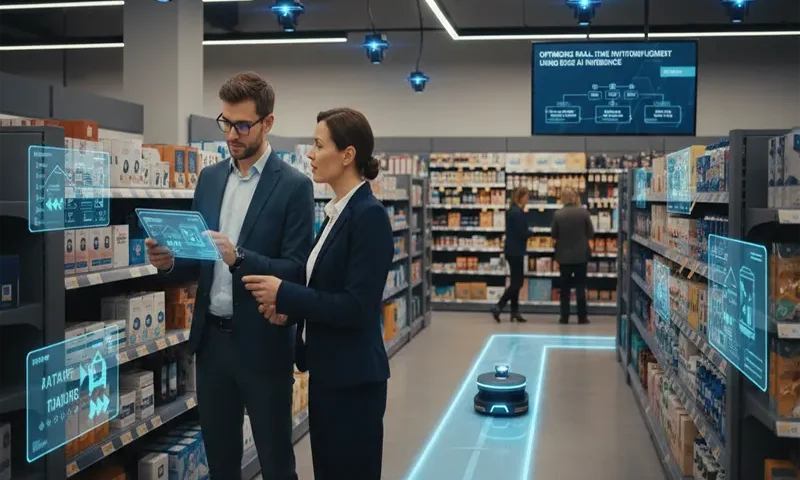
For brick-and-mortar retailers, the cost of “phantom inventory” and out-of-stock (OOS) items is more than just a missed sale—it is an erosion of customer loyalty. Traditional inventory management, reliant on manual counts and periodic audits, is too slow to keep pace with modern consumer demand. Edge AI Inference offers a transformative solution by shifting the “intelligence” from distant cloud servers directly to the store floor.
By processing visual and sensor data locally, retailers can achieve near-instantaneous shelf visibility, automate replenishment alerts, and maintain planogram compliance without the crippling latency or bandwidth costs of cloud-based systems. This article explores the technical architecture and strategic advantages of deploying Edge AI to bridge the gap between physical reality and digital inventory records.
1. The High Cost of the Empty Shelf
In the current retail landscape, inaccuracy is the norm. Industry data suggests that on-shelf availability often hovers around 92%, meaning nearly one in ten items a customer seeks is missing. For a large-box retailer, this “out-of-stock” gap translates into billions in lost revenue annually.
While cloud-based AI has attempted to solve this through computer vision, it faces two primary hurdles:
- Latency: Sending 4K video feeds to the cloud for analysis takes seconds, while inventory needs are measured in milliseconds.
- Data Gravity: Streaming constant video from 500+ cameras per store is cost-prohibitive in terms of network bandwidth.
Edge AI solves this by performing inference at the source, turning “video data” into “inventory metadata” locally.
2. The Architecture of Edge AI in Retail
Moving inference to the edge requires a specialized hardware and software stack designed for high-performance, low-power environments.
The Tech Stack: From Lens to Log
- Visual Sensors: High-resolution smart cameras or existing CCTV feeds.
- Edge Gateways: Local compute nodes (e.g., NVIDIA Jetson, Intel Movidius, or Google Coral) that host the AI models.
- The Inference Engine: Lightweight, optimized neural networks (like YOLOv11 or MobileNet) that detect SKUs, empty gaps, and misplaced items.
- Hybrid Sync: Only the final “results”—such as “Shelf 4, Aisle 2 is out of Milk”—are sent to the cloud-based ERP, reducing bandwidth usage by up to 90%.
3. Computer Vision: Beyond Simple Motion Detection
The “magic” of Edge AI lies in its ability to understand the physical shelf.
- On-Shelf Availability (OSA): The system continuously monitors “facings.” When a product count drops below a specific threshold, it triggers a real-time notification to a store associate’s handheld device.
- Planogram Compliance: The AI compares the current shelf state against the “master plan” (the planogram). It can instantly flag if a premium brand has been pushed to a bottom shelf or if a competitor’s product has “drifted” into the wrong slot.
- Fraud and Shrinkage: Beyond inventory, edge models can detect suspicious patterns at self-checkout or identifies “sweethearting” (where items are moved past the scanner without being rung up).
4. Key Benefits of the Edge-First Approach
| Metric | Cloud AI | Edge AI | Why it Matters |
| Response Time | 1–5 Seconds | < 100 Milliseconds | Faster alerts = faster restocking. |
| Bandwidth | High (Full Video) | Low (Metadata Only) | Saves thousands in monthly ISP costs. |
| Data Privacy | PII sent to cloud. | PII redacted locally. | Compliance with GDPR and local privacy laws. |
| Offline Resilience | System fails if internet is down. | Functions autonomously 24/7. | Critical for stores in rural or low-connectivity areas. |
5. Overcoming Implementation Hurdles
Deploying Edge AI across 1,000 stores is not without challenges. Technical architects must prioritize two key areas:
I. Model Optimization (Quantization & Pruning)
Standard AI models are too “heavy” for edge chips. Solutions Architects use Quantization (reducing 32-bit floats to 8-bit integers) and Pruning (removing redundant neural pathways) to shrink models by 70% or more without losing significant accuracy.
II. Environmental Variables
Store lighting, shadows, and plastic packaging (glare) can confuse basic models. Robust Edge AI requires synthetic data training to ensure the model can recognize a cereal box even if it’s partially obscured or under harsh LED glare.
6. The Path to the “Autonomous Store”
Edge AI is the foundation of the “Store of the Future.” It turns the physical store into a giant, living data set that manages itself. By moving compute to the edge, retailers don’t just see their inventory—they understand it in real-time. This transition reduces waste, empowers employees to focus on customers rather than counting boxes, and ensures that when a customer walks through the door, the product they want is exactly where it’s supposed to be.

