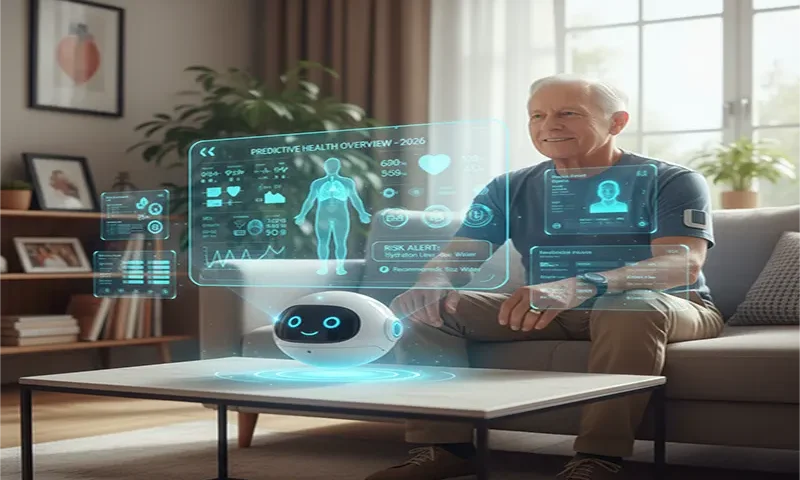
The Guardian in the Living Room: Multimodal AI Agents for Predictive Chronic Disease Management at Home in 2026

For decades, chronic disease management was a game of “catch-up.” A patient with heart failure would wait for overt symptoms—shortness of breath or swollen ankles—before seeking care, often resulting in an expensive emergency room visit. By 2026, the paradigm has shifted. The “Hospital-at-Home” model has matured from a pilot project into a global standard, powered by Multimodal AI Agents. These are not mere monitoring tools; they are autonomous digital guardians that fuse disparate data streams to predict clinical decline days before a patient even feels unwell.

Beyond Single-Stream Data: The Power of Sensor Fusion

In 2024, remote monitoring was often limited to single-parameter alerts—a “high heart rate” or “low oxygen” notification. In 2026, Multimodal AI leverages Sensor Fusion to create a high-definition picture of patient health. By correlating physiological, behavioral, and environmental data, these agents detect cross-parameter interactions that humans might miss.

Multimodal Data Fusion: From Modality to Clinical

Read More
Efficiency Benefits of Tandem Perovskite-Silicon Solar Cells for Portable Power

In the race to decarbonize our energy grid, the humble silicon solar cell has been the workhorse for over half a century. However, as of early 2026, the industry has hit a wall. Traditional single-junction silicon cells are rapidly approaching their theoretical “Shockley-Queisser” limit of approximately 29%. To push further—especially for the demanding world of portable power where every gram of weight and every square centimeter of space matters—we must look to the “Tandem” revolution.

The integration of perovskite and silicon into a single, stacked device is not just an incremental improvement; it is a fundamental leap that is redefining what “off-grid” power looks like.

1. Breaking the Shockley-Queisser Limit

The primary limitation of silicon is its fixed bandgap of roughly 1.12 eV. This means it is highly efficient at capturing red and infrared light but loses the energy of high-energy blue and ultraviolet (UV) photons as waste heat.… Read More

The Interoperability Imperative: Strategic FHIR Adoption for Health Systems in 2026

As of January 1, 2026, the healthcare industry has officially crossed the rubicon of data liquidity. For years, the Fast Healthcare Interoperability Resources (FHIR) standard was viewed by many C-suites as a regulatory “box to check.” Today, however, the landscape has shifted. Fueled by the enforcement of the CMS-0057-F final rule and the maturity of USCDI v6, FHIR has evolved from a compliance burden into a non-negotiable prerequisite for value-based care, administrative efficiency, and the deployment of clinical-grade AI.

Strategic interoperability in 2026 is no longer just about “moving data”; it is about Data Utility—ensuring that information is liquid, semantically accurate, and available at the precise moment of clinical or administrative need.

The FHIR Maturity Model: From HL7 v2 to RESTful Liquidity

The transition from legacy HL7 v2 and v3 messaging to FHIR R4 and R5 represents a shift from “pushing” static documents to “pulling” granular, discrete data … Read More

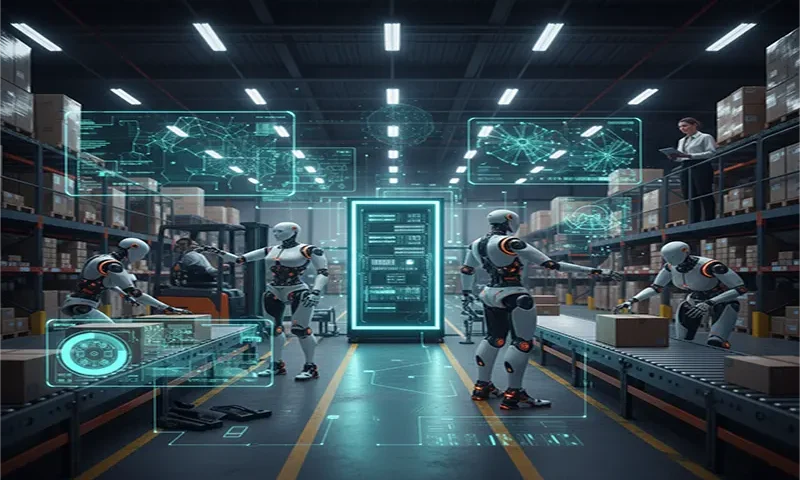
Training Embodied AI Models for Multi-Functional Humanoid Robots in Logistics

The logistics industry is currently standing at the precipice of a paradigm shift. For decades, “automation” meant fixed conveyor belts and Automated Guided Vehicles (AGVs) following magnetic strips. Today, we are moving toward Autonomy, powered by Embodied AI—the intelligence that allows a machine to perceive, reason, and physically interact with its environment in a human-like way.

1. From Automation to Autonomy: The Humanoid Necessity

Traditional warehouse robots are specialized. A robotic arm picks; a wheeled base moves. However, the modern supply chain is messy and “unstructured.” Boxes fall, aisles get cluttered, and loading docks are rarely uniform.

Humanoid robots represent the ultimate “general-purpose” tool. Because our world is built by humans for humans, a humanoid form factor allows a robot to navigate stairs, reach high shelves, and operate manual equipment without requiring us to redesign the entire warehouse. Embodied AI is the “brain” that turns this mechanical frame into … Read More

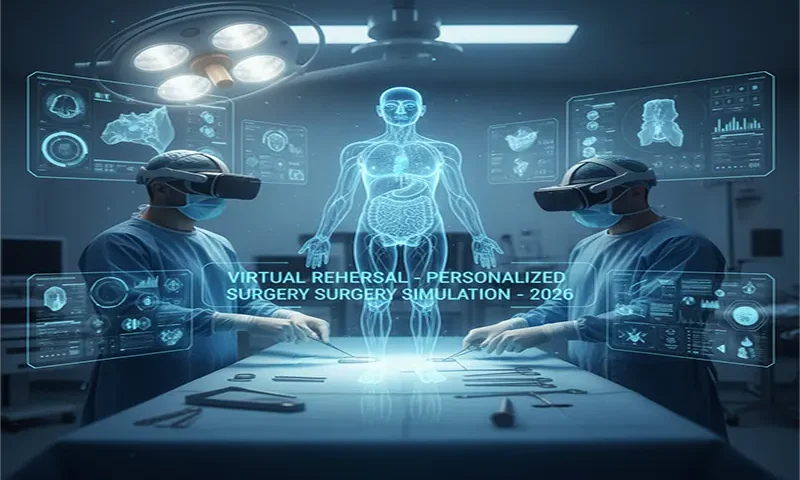
The Virtual Rehearsal: Personalized Medical Simulations Using Human Digital Twins for Surgery in 2026

For decades, surgery has been a discipline of “averages”—surgeons applied techniques that worked for the average patient, adjusted by their own intuition and experience. But as we move through 2026, the arrival of the Human Digital Twin (HDT) has ushered in the era of “One-Size-Fits-One” medicine. This is no longer just about viewing a 3D scan on a monitor; it is about creating a living, breathing virtual replica of a patient that mirrors their unique anatomy, physiological responses, and even their long-term healing patterns.

Defining the Surgical Digital Twin (SDT)

In 2026, the medical community distinguishes between simple 3D reconstructions and the Shadow Twin. While a standard model might show the shape of a heart, a Shadow Twin integrates real-time data to simulate biomechanical properties like tissue elasticity and fluid dynamics.

By fusing MRI/CT scans with genomic data and real-time inputs from clinical-grade wearables, the HDT becomes a … Read More