
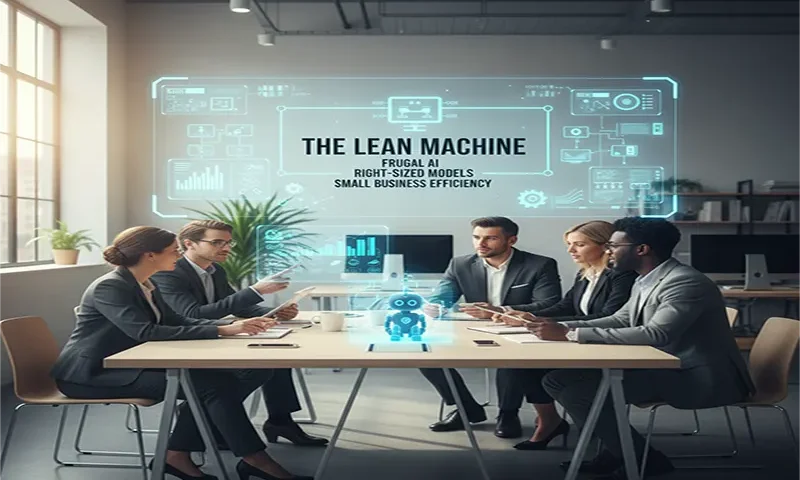
In the early days of the AI boom, the prevailing wisdom was “bigger is better.” Enterprises raced to integrate the largest, most expensive models available, often using a massive 400B+ parameter model to perform tasks as simple as summarizing an internal email. By 2026, however, the “AI Arms Race” has matured into the Efficiency Era.
For small businesses, the competitive edge no longer comes from having the largest AI, but from implementing Frugal AI: a strategy centered on high-performance, Right-Sized Models that provide 95% of the utility at less than 5% of the cost.
The Fallacy of “Bigger is Better”
The most significant drain on small business AI budgets in 2025 was “Over-Provisioning.” Using a frontier model like GPT-4o or Claude 3 Opus for routine data entry is like using a rocket ship to go to the grocery store.
In 2026, small businesses are embracing the Latency-Cost-Accuracy Triangle. Giant models are accurate but slow and expensive. Small Language Models (SLMs) are lightning-fast and virtually free to run, provided they are specialized for a specific task. By matching the model size to the complexity of the job, businesses are slashing their Inference Costs without sacrificing quality.
The Rise of Small Language Models (SLMs)
The breakthrough of 2026 is the capability of “Right-Sized” models like Mistral 7B, Phi-3, or the Llama-3-8B family. These models are compact enough to run on a single local workstation or a budget-friendly cloud instance, yet they outperform the giant models of 2023 in specialized tasks.
Model Selection Guide: Task vs. Recommended Size
| Business Task | Complexity | Recommended Model Size | 2026 Examples |
| Customer Support (FAQ) | Low | < 3B Parameters | Gemma 3 (2B), Phi-3 Mini |
| Content Drafting / Email | Medium | 7B – 14B Parameters | Mistral 7B, Llama 4 (8B) |
| Data Analysis / Coding | High | 30B – 70B Parameters | Qwen3-Next (32B), Llama 4 (70B) |
| Strategic Planning | Extreme | 400B+ Parameters | GPT-5, Claude 4 |
The 3 Pillars of Frugal AI Deployment
To build a “Lean Machine,” small businesses are moving away from total dependence on external APIs and toward a three-pillared local/hybrid approach.
Pillar 1: Model Distillation
Distillation is the process where a “Teacher” model (a giant, expensive AI) is used to train a “Student” model (a small, frugal AI).
- The Process: You use a frontier model to generate 10,000 high-quality examples of how your company handles customer returns. You then fine-tune a tiny 1B parameter model on that specific data.
- The Result: A specialist model that handles your returns better than the giant AI ever could, at near-zero operating cost.
Pillar 2: Local Hosting and Quantization
In 2026, Quantization is the magic word for efficiency. It is a technique that “shrinks” the numerical precision of a model (e.g., from 16-bit to 4-bit) with negligible loss in accuracy. This allows a powerful 8B model to run on a standard office computer with an NVIDIA RTX card or a Mac Studio.
- Tools of the Trade: Small businesses are utilizing tools like Ollama, LM Studio, and vLLM to host these models locally, ensuring data privacy and eliminating monthly API subscriptions.
Pillar 3: RAG over Fine-Tuning
Instead of the expensive process of “teaching” an AI your company data through fine-tuning, frugal businesses use Retrieval-Augmented Generation (RAG). This allows a small, efficient model to “read” your company’s PDFs and spreadsheets in real-time to answer questions, keeping the model lightweight and easy to update.
Case Study: The “Frugal AI” Budget Shift
Consider a small marketing agency processing 50,000 requests per month.
- 2024 Approach (Frontier API Only): * Model: GPT-4 Turbo
- Average Cost: $1,250 / month
- Risk: Total dependence on external pricing and uptime.
- 2026 Frugal Approach (Hybrid/Local):
- Model: Local Llama-3-8B (Quantized) for 90% of tasks; GPT-4o Mini for 10% complex tasks.
- Average Cost: $45 / month (Cloud electricity/hosting)
- Result: 96% cost reduction with improved data security.
Overcoming the Implementation Gap
The biggest hurdle for small businesses isn’t the technology—it’s the talent. However, the “No-Code” movement has reached local AI. In 2026, tools like AnythingLLM or Jan provide a “Click-to-Install” experience for local models, allowing an office manager or IT generalist to deploy a company-wide AI without a Data Science degree.
Complexity is the Enemy of Profit
The future of small business AI is not found in the clouds of Silicon Valley, but in the optimized hardware of the local office. By embracing Frugal AI, businesses can “punch above their weight,” leveraging specialized, Right-Sized Models to automate the mundane while keeping their data—and their profit margins—protected.

