
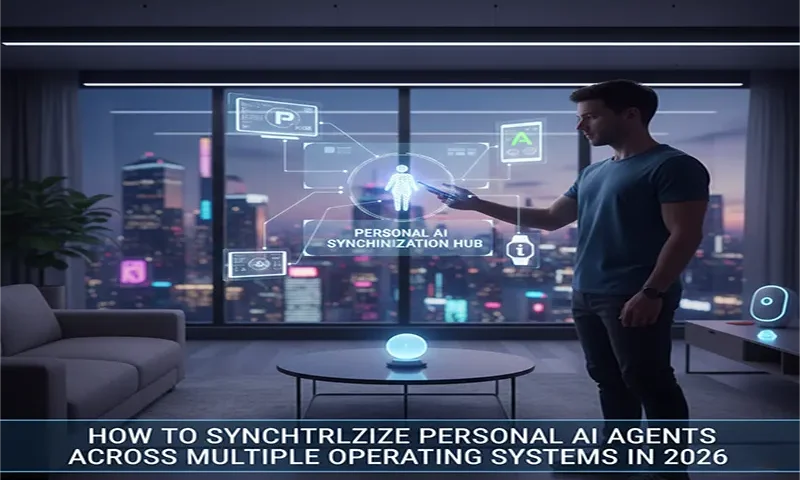
In 2026, the digital landscape has moved beyond the era of isolated chatbots. We are now in the age of Agentic Continuity. Users no longer want to re-explain their preferences to a Windows Copilot if they just spent the morning briefing their Android-based assistant.
Synchronizing a personal AI across multiple operating systems today relies on three core pillars: Standardized Protocols, Decentralized Identity, and Cross-Platform Semantic Memory.
1. The Fragmentation Problem: The “Siloed Assistant”
By late 2025, it became clear that the biggest friction point in AI was “Context Amnesia.” You would set a reminder on your iPhone, but your Linux workstation’s agent had no record of it.
The 2026 solution is the Autonomous Personal Entity (APE). Instead of being an app inside an OS, your AI is now a sovereign layer that interfaces with the OS. This shift allows your agent to maintain a persistent “soul”—your memories, learned behaviors, and active task states—regardless of whether you are on a phone, a desktop, or a smart wearable.
2. The Backbone: MCP & A2A Protocols
The secret to 2026 interoperability lies in two standardized languages that allow different AI models to talk to each other and to your tools.
- Model Context Protocol (MCP): Developed as a “USB-C for AI,” MCP provides a universal interface for your agent to plug into local files, databases, and APIs. If your Windows agent uses MCP to read a spreadsheet, your Android agent can use the same protocol to pick up exactly where you left off.
- Agent-to-Agent (A2A) Protocol: This protocol allows “specialized” agents to collaborate. Your Apple Intelligence agent can use A2A to “hand over” a task to your Linux-based coding agent, sharing the necessary context cards and task history securely.
3. Step-by-Step Sync Strategy
Layer 1: The Identity Layer (Who You Are)
In 2026, we avoid “Login with Google/Apple” for AI. Instead, we use Decentralized Identifiers (DIDs). A DID is a cryptographically verifiable ID that you own. When you move to a new device, you simply “resolve” your DID. This proves to the local OS that you are the owner of the AI agent’s “brain,” allowing it to pull your encrypted memory without needing a central corporate middleman.
Layer 2: The Semantic Memory Layer (What You Know)
The “brain” of your AI is a Personal Vector Database. Tools like Turso (running SQLite with vector support) or synchronized Milvus instances allow your AI to store “embeddings” (mathematical representations of your thoughts/data).
- How to sync: Use a peer-to-peer (P2P) sync engine or a secure cloud “vault” to replicate your vector DB across devices. Your agent then performs “Similarity Searches” on this local data to remember that “the project from this morning” refers to the specific code you wrote on your Mac.
Layer 3: The State Orchestration Layer (What You’re Doing)
This layer handles “Handoffs.” 2026 Agentic OSs use Task Lifecycle Management.
- Workflow: You start an email on Android. The task state is saved as a “JSON Artifact.” When you open your Windows PC, the A2A server broadcasts the “In-Progress” status. Your Windows agent sees the artifact and restores the draft, the tone, and even the “un-sent” context.
4. Sync Protocol Comparison: 2026 Standards
| Protocol | Primary Role | OS Compatibility | Best For… |
| MCP | Local Tool/Data Access | Universal | Reading local files and system settings. |
| A2A | Agent-to-Agent Logic | Multi-Vendor | Moving a task from a Phone Agent to a PC Agent. |
| DIDs | Identity & Ownership | Platform Agnostic | Proving you own your AI context without a password. |
| Vector Sync | Long-term Memory | Linux, Win, Mobile | Remembering facts, names, and past conversations. |
5. 5-Minute Cross-Platform Setup Checklist
- [ ] Generate a DID: Use a wallet (like IOTA or ArcBlock) to create your unique Decentralized Identifier.
- [ ] Select a Memory Vault: Set up a personal vector database (e.g., Pinecone Serverless or a local Turso instance) for context storage.
- [ ] Enable A2A Discovery: Ensure “Agent Discovery” is turned on in your OS settings to allow your devices to “see” each other’s agent cards.
- [ ] MCP Mapping: Point your agent’s MCP servers to the specific folders (Documents, Work, Creative) you want it to monitor across all devices.
- [ ] Verify Encryption: Ensure your “Sync Key” is stored in your hardware’s Secure Enclave (TPM on Windows, Titan on Android).
6. Digital Sovereignty
Synchronizing your personal AI in 2026 is about moving from “Platform as a Service” to “Self-Sovereign Agency.” By using DIDs for identity and MCP/A2A for communication, you ensure that your digital companion is as mobile as you are. You are no longer renting an AI from a tech giant; you are carrying a “Unified Mind” that respects your privacy and works wherever you do.

