

AI Ethics and Bias Detection: Project Ideas for High School Students
Have you ever noticed how some online ads seem to read your mind, or how a social media algorithm keeps showing you content you already agree with? That’s Artificial Intelligence (AI) at work, making predictions and decisions based on vast amounts of data. While AI promises incredible advancements, it also carries a hidden risk: bias. Just like humans, AI can be unfair, make mistakes, and even perpetuate societal prejudices if not designed and monitored carefully. For high school students, understanding and tackling AI ethics isn’t just a fascinating academic exercise—it’s preparing you to be the architects of a fairer, smarter future.
The Mechanics of Bias
So, how does bias sneak into an AI system? It’s not usually malicious intent; rather, it’s often an accidental byproduct of how AI learns. Imagine teaching a child about cats using only pictures of fluffy, orange tabbies. If they later see a sleek, black … Read More


How to measure ROI of agentic AI in enterprise workflows
As enterprises move from static chatbots to Agentic AI—systems capable of reasoning, using tools, and executing multi-step workflows—the traditional metrics for calculating Return on Investment (ROI) are becoming obsolete. Measuring the value of an autonomous agent requires a shift from “cost-per-task” to “value-per-outcome.” This article outlines a comprehensive framework for quantifying the impact of agentic workflows, focusing on operational autonomy, strategic scalability, and the mitigation of human error costs.
1. The Shift from Automation to Autonomy
For decades, enterprise ROI was calculated through the lens of Robotic Process Automation (RPA): How many human hours did this script replace? With the advent of Generative AI, that metric shifted slightly toward Productivity: How much faster can an employee write this email?
Agentic AI represents a fundamental paradigm shift. Unlike a standard LLM that waits for a prompt, an agent is given a goal (e.g., “Research this lead, find their … Read More
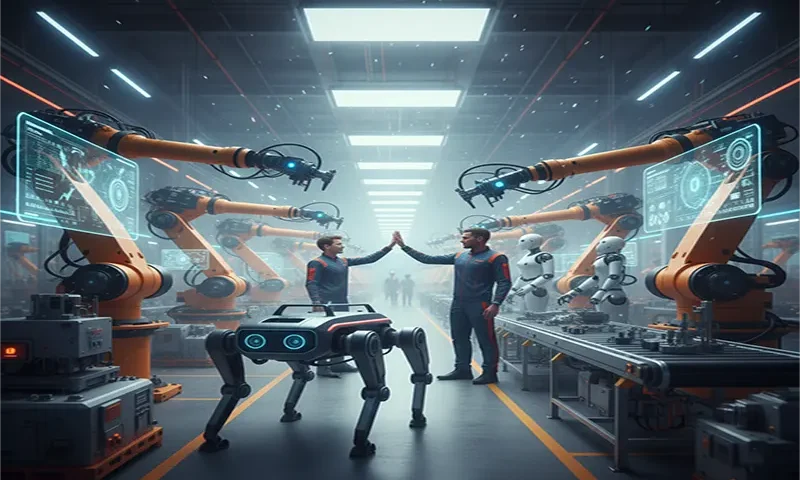
Physical AI and Collaborative Robotics: The Smart Manufacturing Revolution of 2026
For decades, industrial robots were the “strong, silent types” of the factory floor—powerful machines bolted to the ground, performing repetitive tasks behind heavy safety cages. But as we move through 2026, those cages are coming down. We have entered the era of Physical AI, where artificial intelligence has finally “grown a body.”
In 2026, the global industrial robotics market has surged toward a $54 billion valuation, driven by a generational shift from rigid automation to intelligent, self-evolving systems. This isn’t just about faster arms; it’s about a fundamental transformation in how machines perceive, reason, and interact with the physical world.
The Rise of Physical AI: From Code to Contact
The biggest story of 2026 is the transition from “Digital AI” (chatbots and image generators) to Physical AI. While previous generations of robots relied on thousands of lines of explicit code for every movement, today’s systems are powered … Read More
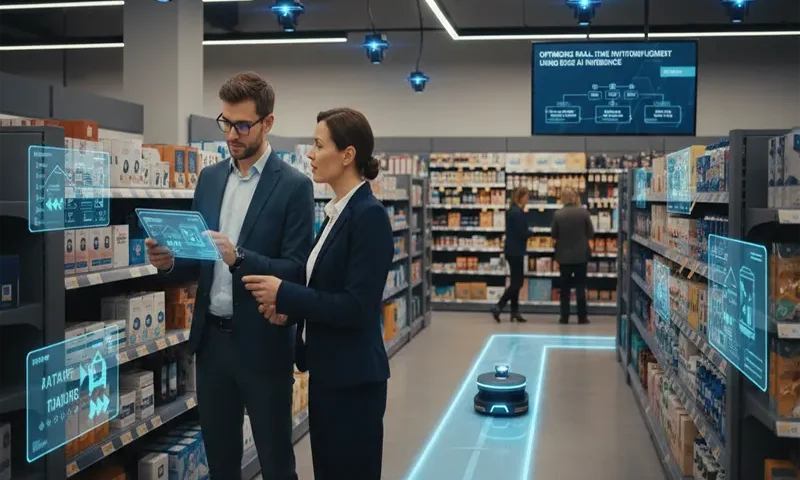
Optimizing real-time inventory management using edge AI inference in brick-and-mortar stores
For brick-and-mortar retailers, the cost of “phantom inventory” and out-of-stock (OOS) items is more than just a missed sale—it is an erosion of customer loyalty. Traditional inventory management, reliant on manual counts and periodic audits, is too slow to keep pace with modern consumer demand. Edge AI Inference offers a transformative solution by shifting the “intelligence” from distant cloud servers directly to the store floor.
By processing visual and sensor data locally, retailers can achieve near-instantaneous shelf visibility, automate replenishment alerts, and maintain planogram compliance without the crippling latency or bandwidth costs of cloud-based systems. This article explores the technical architecture and strategic advantages of deploying Edge AI to bridge the gap between physical reality and digital inventory records.
1. The High Cost of the Empty Shelf
In the current retail landscape, inaccuracy is the norm. Industry data suggests that on-shelf availability often hovers around 92%, meaning nearly one in … Read More

Best AI Tools for Digital Creators in 2025: Image, Video, and Content Editing Compared
As of October 2025, AI-powered creative tools have become essential for video editors, content creators, and digital marketers. From lip sync AI to image to video generators, these platforms are redefining how creators produce professional-quality content at scale. I tested the leading tools hands-on to evaluate usability, output quality, and pricing—here are the top picks AI Talking Photo.
Magic Hour – The All-in-One AI Creative Suite
Magic Hour stands out as the most complete and reliable platform I tested. It combines lip sync, face swap, and image to video AI features with a seamless interface. For creators who want professional-quality results without juggling multiple apps, this tool is unmatched.
Pros:
- Clean, intuitive UI with quick onboarding
- Multiple features (lip sync, face swap, ai image editor) in one place
- Supports prompt-free editing with AI-powered suggestions
- High-quality output suitable for professional campaigns
Cons:
- Web-based only, no native desktop