
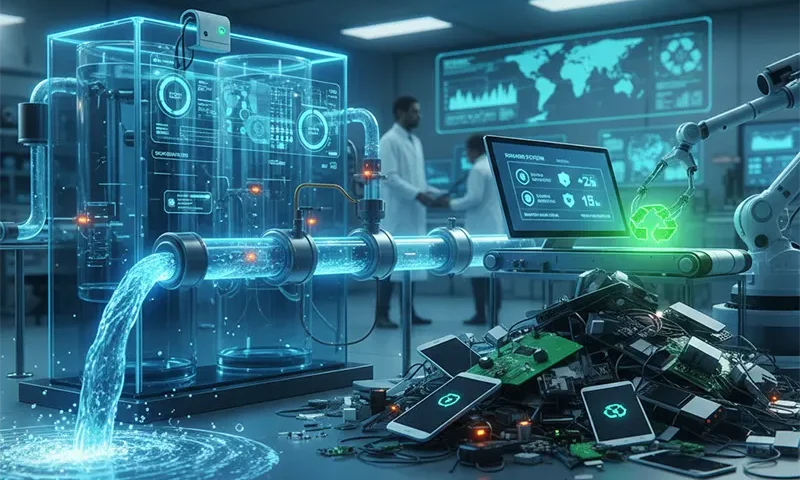
As the global population surges toward 8.5 billion, our urban centers are facing a double-edged environmental crisis: the accelerating depletion of “liquid gold”—fresh water—and the toxic accumulation of “digital mines”—electronic waste (e-waste). Traditional management systems are no longer sufficient; they are reactive, manual, and disconnected. However, the maturation of the Internet of Things (IoT) offers a transformative path forward. By weaving a web of intelligent sensors and incentivized behavioral models, we can move toward a “Closed-Loop Smart City” where resources are monitored in real-time and waste is treated as a high-value asset.
Part 1: IoT-Driven Smart Water Management
Water scarcity is often exacerbated not just by climate change, but by invisible inefficiencies. In many aging cities, up to 30% of treated water is lost to leaks before it ever reaches a faucet. IoT-driven management shifts the paradigm from “break-fix” to “predict-and-prevent.”
Precision Monitoring and Acoustic Intelligence
The first layer of a smart water system involves the deployment of Ultrasonic Smart Meters and Acoustic Leak Detectors. Unlike mechanical meters, ultrasonic sensors have no moving parts and can detect even the slightest change in flow velocity. When integrated with acoustic sensors placed along trunk lines, the system can “listen” for the specific frequencies generated by pipe fissures. AI algorithms analyze these sound patterns to pinpoint the location of a leak within a few meters, allowing utilities to repair infrastructure before a catastrophic burst occurs.
Smart Irrigation and Soil Health
Beyond infrastructure, urban water use is dominated by landscaping. Traditional timed sprinklers are notoriously wasteful, often running during rainstorms. IoT-based Precision Irrigation utilizes soil moisture sensors and atmospheric pressure gauges. These devices transmit data via LoRaWAN (Long Range Wide Area Network) to a central controller. If the soil moisture levels are above a specific threshold or if the local weather API predicts rain within six hours, the system automatically suppresses the irrigation cycle, potentially saving millions of gallons per year in a single metropolitan area.
Part 2: The E-Waste Reward Ecosystem
While water is lost through leaks, rare earth metals and valuable plastics are lost through the improper disposal of electronics. E-waste is the fastest-growing waste stream in the world. To solve this, we must move beyond the “guilt-based” recycling model to an Incentivized Circular Economy.
The IoT “Smart Bin” for Electronics
Imagine a network of specialized, IoT-enabled collection kiosks—Smart Bins—located in malls, schools, and transit hubs. These bins are equipped with:
- RFID and AI Visual Recognition: To identify the type of device being deposited (e.g., a lithium-ion battery vs. an old smartphone).
- Automated Weight and Condition Sensors: To estimate the “residual value” of the components.
- Connectivity: To update the user’s digital profile instantly upon disposal.
Digital Tokens and Carbon Credits
The bottleneck of recycling is participation. To solve this, we can implement a Gamified Reward System. When a student or citizen drops an old laptop into a Smart Bin, the IoT system verifies the device and issues Digital Tokens (or “Green Credits”) to their mobile wallet.
These credits function as a local currency. They could be redeemed for:
- Discounts on public transportation.
- Vouchers for energy-efficient electronics (closing the loop).
- Direct deductions from municipal utility bills.
By using Blockchain to log these transactions, the city ensures a transparent, tamper-proof record of the “chain of custody,” proving that the hazardous materials were handled by certified recyclers rather than ending up in a landfill.
Part 3: The Synergy—The Unified Citizen App
The true power of these systems lies in their integration. A single “Green City” App can serve as the interface for both water conservation and e-waste management. This synergy creates a holistic environmental consciousness for the user.
For example, a household that maintains water usage below a certain “sustainability benchmark” (monitored by their IoT meter) could receive a multiplier on their e-waste rewards. Conversely, points earned from recycling a tablet could be used to offset a high water bill during a summer heatwave. This interconnectedness encourages citizens to view their environmental footprint as a balanced ledger. From a municipal perspective, the data collected from both systems provides a heat map of urban sustainability, allowing leaders to allocate resources to neighborhoods that struggle with either water loss or high electronic turnover.
Technical Stack Summary
The implementation of such a dual system requires a robust, multi-layered technology stack.
| Layer | Technology | Function |
| Edge Sensing | Ultrasonic Flow Sensors, Soil Moisture Probes, RFID, AI Cameras | Data collection from the physical environment. |
| Connectivity | LoRaWAN, NB-IoT, 5G | Low-power, long-range transmission of sensor data. |
| Data Processing | MQTT Brokers, Cloud Data Lakes (AWS/Azure) | Real-time ingestion and storage of billions of data points. |
| Intelligence | Machine Learning (Anomaly Detection) | Predictive maintenance and reward validation. |
| User Interface | Mobile Apps / Blockchain Wallets | Citizen engagement and reward distribution. |
Technical Challenges & Solutions
Deploying thousands of sensors across a city is not without hurdles:
- Battery Life: For water sensors buried underground, changing batteries is expensive. The solution lies in LPWAN (Low Power Wide Area Networks), which allow sensors to operate for 5–10 years on a single charge.
- Data Privacy: Real-time water usage can reveal when a person is home. To mitigate this, data must be anonymized at the edge and encrypted during transit.
- The Rebound Effect: There is a risk that people might use more water because they feel “forgiven” by their recycling efforts. Continuous education and dynamic pricing models within the app can help maintain the focus on total conservation.
The Invisible Infrastructure of Sustainability
The future of the smart city is one where the infrastructure cares for itself. By integrating IoT-based smart water management with an e-waste reward system, we stop viewing environmental protection as a series of chores and start seeing it as an optimized, rewarding lifestyle. In this vision, sensors act as the city’s nervous system—detecting “wounds” in water pipes and identifying “nutrients” in discarded electronics. As we move closer to the 2030 sustainability goals, these intelligent systems will be the difference between a city that merely survives and one that truly thrives in a resource-constrained world.

