
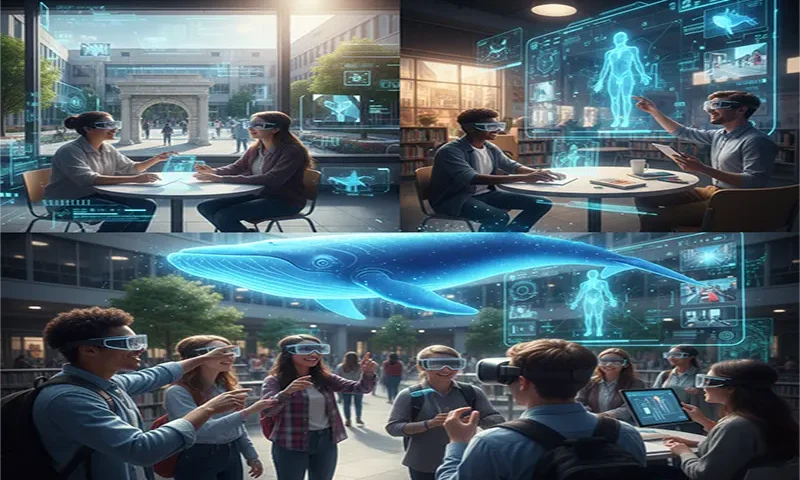
In 2026, the traditional lecture hall is no longer the sole center of the university experience. The arrival of spatial computing has shifted the educational paradigm from “observing” to “inhabiting.” As colleges strive to bridge the gap between theoretical knowledge and career readiness, Virtual Reality (VR) and Augmented Reality (AR) have emerged as the primary catalysts for immersive learning.
The “Metaversity”—a persistent, shared virtual campus—has moved from a buzzword to a functional reality. Enabled by 5G-Advanced networks and lightweight, high-fidelity headsets, students are now engaging in projects that were physically impossible or financially prohibitive just five years ago.
The Pedagogy of Presence
Why does VR work so much better than a textbook? The answer lies in spatial presence—the psychological state where a user’s sensory system is so thoroughly engaged that they feel they are “there” in the environment. In 2026, educational researchers have solidified the data: students retain 75% of what they experience in VR, compared to a mere 10% for passive reading.
By engaging the motor cortex through haptic feedback and the emotional centers of the brain through narrative-driven environments, immersive projects turn abstract data into “lived memories.” This is not just learning; it is an experiential bypass of traditional cognitive fatigue.
Discipline-Specific Project Ideas
To help students and faculty navigate this landscape, we have categorized the most impactful immersive projects currently being deployed on modern campuses.
1. STEM: The AI-Enhanced Virtual Lab
Gone are the days of simple pre-recorded simulations. High-level 2026 projects involve AI-integrated virtual laboratories.
- The Project: Students manipulate individual molecules using haptic gloves to understand protein folding.
- The Twist: The simulation uses physics-based AI to show the exact chemical reaction in real-time. If a student creates an unstable compound, they witness a safe, virtual explosion.
- Impact: This provides a consequence-based learning experience for high-risk chemistry or nuclear physics experiments that would be too dangerous for a physical undergraduate lab.
2. Medical & Healthcare: The “Patient Perspective” Simulation
In the medical field, VR has moved beyond anatomy into the realm of empathy and surgical precision.
- The Project: AR-assisted surgical rehearsals. Students overlay a digital “twin” of a patient’s specific MRI scan onto a physical mannequin to practice a complex procedure.
- The Empathy Factor: Using VR to simulate the visual and auditory distortions associated with conditions like schizophrenia or macular degeneration.
- Impact: This fosters clinical empathy, allowing future doctors to understand the subjective experience of the patients they treat.
3. Humanities & Social Sciences: Historical Witnessing
History often feels like a collection of dry dates. Immersive learning turns it into a field of study based on observation.
- The Project: Students enter a photorealistic reconstruction of an ancient Roman Agora or a 1960s civil rights protest.
- The Methodology: Students are tasked with conducting “virtual ethnographies,” observing the social dynamics and power structures of a reconstructed era.
- Impact: This shifts history from a “read-only” subject to a “witness-and-analyze” discipline.
4. Architecture & Engineering: Collaborative BIM
Building Information Modeling (BIM) has reached its zenith with asynchronous collaboration in 3D.
- The Project: Architecture students from three different global universities meet inside a shared 1:1 scale model of their design.
- The Interaction: They can “walk” through the structural frame, check for pipe interferences, and use AR to visualize how sunlight will hit the building at different times of the year.
- Impact: This prepares students for the globalized, remote-work reality of modern engineering firms.
The “Metaversity” and Social Learning
One of the most profound shifts in 2026 is the move toward Persistent Virtual Spaces. Unlike a Zoom call that ends when you hang up, a Metaversity project space remains “live.” A group of students can leave a 3D brainstorm board active in a virtual room, return two days later, and find that their AI-tutor has organized their notes into a 3D hierarchy.
This social layer solves the “isolation” problem of early VR. Students are no longer alone in a headset; they are in a digital commons, seeing their peers’ avatars, reading their body language, and engaging in spontaneous “hallway conversations” that are crucial for the college experience.
Technical Implementation & The Tech Stack
Developing these projects has become more accessible thanks to the “Low-Code/No-Code” revolution in spatial engines.
- Engines: Unity and Unreal Engine 5 remain the gold standards for high-fidelity VR.
- Accessibility: WebXR is increasingly used for lighter AR projects, allowing students to access immersive content through a simple smartphone browser.
- AI Integration: Large Language Models (LLMs) are now used to power “Dynamic NPCs” (Non-Player Characters) in historical or medical simulations, allowing students to have unscripted conversations with virtual patients or historical figures.
Project Feasibility Table
| Project Category | Complexity | Educational Impact | Technology Required |
| AR Textbook Overlays | Low | Medium | Smartphone / WebXR |
| Virtual Field Trips | Medium | Medium | VR Headset / 360 Video |
| Historical Witnessing | Medium | High | Unity / Meta Quest 3/4 |
| AI-Surgical Rehearsal | High | Extreme | Haptics / High-end PCVR |
| Collaborative BIM | High | High | Unreal Engine / Cloud Server |
The Boundaryless Classroom
The future of college is not about replacing the physical campus, but about expanding its boundaries. In 2026, immersive learning is the bridge between theory and practice, between the local and the global. By embracing VR and AR project-based learning, universities are ensuring that the next generation of professionals is not just “well-read,” but “well-experienced.” The classroom is no longer four walls; it is whatever world we choose to build.

