
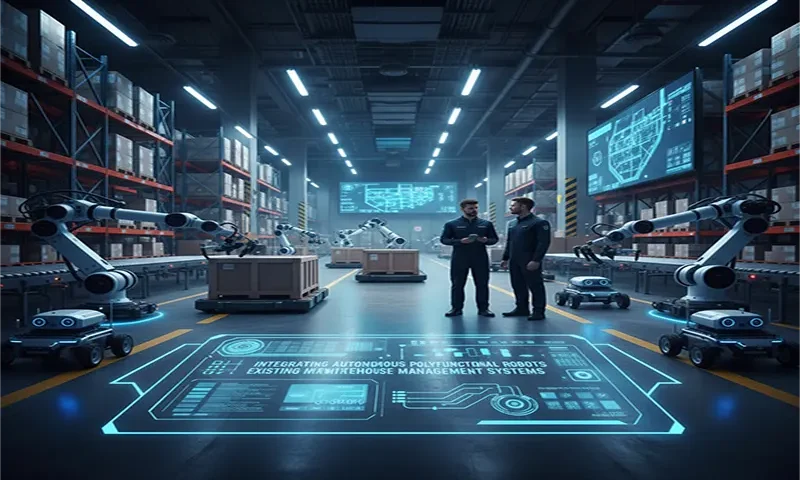
The logistics industry is currently moving from single-task automation to the era of Polyfunctional Robotics—autonomous platforms that can dynamically switch between picking, sorting, and palletizing. However, for most enterprises, the barrier to adoption isn’t the hardware; it’s the “Brownfield Integration Gap.” Legacy Warehouse Management Systems (WMS) are historically designed for linear, human-centric tasks. Integrating robots that change roles throughout a shift requires a move away from rigid, one-to-one connections toward a modular, API-first orchestration layer. This article explores how to bridge this gap using the Robotics Control Layer (RCL) and international interoperability standards like VDA 5050.
1. Introduction: Beyond the Single-Task Bot
Traditional warehouse automation relied on “fixed-function” machines: a conveyor belt moved boxes, a sorter pushed them into bins, and a palletizer stacked them at the end. Polyfunctional robots break this silos. These machines use modular end-effectors (grippers, vacuum suction, or forks) and AI-driven vision to pivot roles based on real-time demand.
The value proposition is clear: instead of purchasing three specialized machines, an enterprise invests in one flexible fleet that maximizes utilization across multiple shifts.
2. The Integration Challenge: The “API Gap”
The primary hurdle in brownfield sites is the legacy WMS. Most older systems communicate via batch processing or flat-file transfers (CSV/XML), whereas autonomous robots require real-time, bidirectional data streams.
Furthermore, a legacy WMS typically views a “resource” as either a human or a fixed machine. It struggles to account for a robot that is a “Picker” at 10:00 AM but transforms into a “Palletizer” at 2:00 PM. Without a middle layer, the WMS risks “double-booking” the robot or failing to update inventory locations in real-time.
3. The Solution: The Robotics Control Layer (RCL)
To avoid a costly “rip-and-replace” of the core WMS, integrators implement a Robotics Control Layer (RCL) or Warehouse Execution System (WES).
WMS vs. RCL Responsibility Matrix
| Feature | WMS Responsibility | RCL/Orchestration Responsibility |
| Inventory Logic | Master record of SKU counts/locations. | Real-time “shelf-level” accuracy. |
| Order Planning | Grouping orders into “Waves.” | Dynamic task allocation to the nearest bot. |
| Pathfinding | N/A (Static bins). | Real-time obstacle avoidance and traffic. |
| Role Assignment | Long-term labor scheduling. | Instant “role-swapping” based on bottlenecks. |
4. Standardization: VDA 5050 and MassRobotics
Interoperability is the key to a future-proof warehouse. If an enterprise uses robots from different vendors (e.g., one for heavy lifting and another for fine-motor picking), they must speak the same language.
- VDA 5050: Originally from the German automotive sector, this protocol allows a single master control system to manage a heterogeneous fleet. It focuses on Command & Control—sending “Missions” to robots regardless of their brand.
- MassRobotics Interoperability Standard: This standard focuses on Status & Awareness. It allows different robots to share their position, speed, and intent, preventing “deadlocks” in narrow warehouse aisles.
5. Workflow Transformation: A Day in the Life
A polyfunctional robot creates a “Liquid Warehouse” where capacity flows where it is needed most:
- Morning Peak (E-commerce): The fleet is equipped with small-item grippers. They act as “Goods-to-Person” AMRs, bringing individual items to packing stations.
- The Mid-Day Swap: As picking volume drops, the robots navigate to an Automated Tool Changer station. They swap their picking grippers for heavy-duty pallet forks.
- Afternoon Bulk (Outbound): The same robots now move to the shipping dock, performing autonomous palletizing and loading, effectively doubling the ROI of the hardware.
6. Data & Analytics: Edge Intelligence
Polyfunctional robots act as “mobile sensors.” As they move, they use Computer Vision to perform “Cycle Counting” in the background. If a robot sees a shelf is empty that the WMS thinks is full, it sends an instant correction. This creates a Self-Healing WMS, where digital records and physical reality are constantly reconciled.
7. Flexibility Over Raw Speed
In a volatile market, the most valuable warehouse is the most adaptable one. Integrating polyfunctional robots into a legacy WMS is a strategic move from “Rigid Automation” to “Elastic Operations.” By using an RCL and adhering to open standards like VDA 5050, enterprises can modernize their brownfield facilities without a total system overhaul, ensuring that their automation can evolve as fast as their customers’ demands.

