
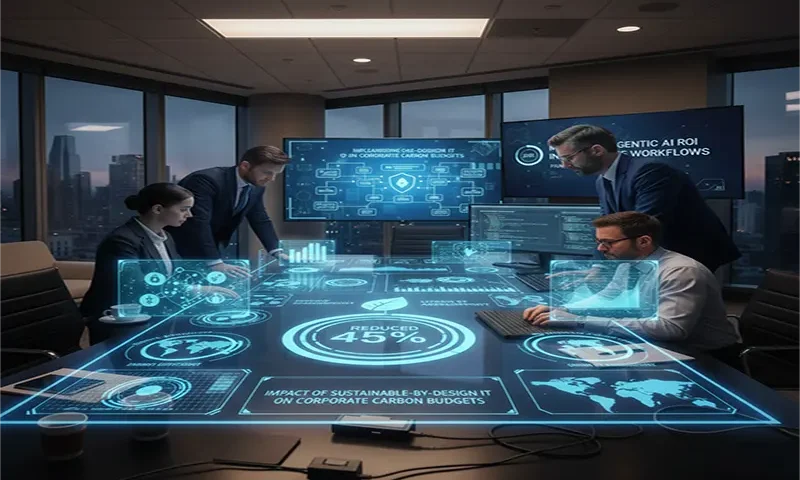
As corporations face intensifying pressure from regulators and investors to reach Net Zero, the IT department is moving from a peripheral concern to the center of the carbon balance sheet. Traditionally, IT infrastructure was designed for “peak performance” and “infinite scale,” with little regard for energy expenditure or hardware disposal.
Sustainable-by-Design IT flips this script. By integrating environmental constraints into the architectural phase—covering software efficiency, hardware longevity, and carbon-aware infrastructure—enterprises can realize a double dividend: a significant reduction in Scope 2 and 3 emissions and a dramatic lowering of operational costs. This article explores how a green-first architecture directly impacts the corporate carbon budget.
1. The Invisible Footprint: IT’s Growing Carbon Liability
For many enterprises, the IT footprint is an “invisible” driver of emissions. While manufacturing or logistics might seem more carbon-intensive, the digital economy now accounts for an estimated 2% to 4% of global greenhouse gas emissions—surpassing the aviation industry.
Corporate carbon budgets are typically divided into three scopes:
- Scope 2: Indirect emissions from the generation of purchased electricity (Data centers and office hardware).
- Scope 3: All other indirect emissions in the value chain, specifically the Embodied Carbon of devices (mining, manufacturing, and transport).
A “Sustainable-by-Design” approach addresses these by treating carbon as a finite resource, similar to a financial budget.
2. The Three Pillars of Green Architecture
I. Software Level: “Green Code” and Algorithmic Efficiency
Sustainable IT begins at the IDE. Software that is poorly optimized requires more CPU cycles, more RAM, and more cooling.
- Energy-Efficient Languages: Shifting performance-critical tasks to languages like Rust or C++ instead of Python can reduce energy consumption for specific workloads by orders of magnitude.
- Minimalism in Design: Reducing “bloatware” and unnecessary background processes directly lowers the energy draw of end-user devices.
II. Hardware Level: Circularity and Embodied Carbon
The most sustainable server is the one you don’t have to buy.
- Extending Lifecycles: Designing IT policies that support a 5-year rather than a 3-year refresh cycle can reduce the annual embodied carbon footprint of a device by approximately 40%.
- Modularity: Prioritizing hardware that can be repaired or upgraded (e.g., modular laptops and servers) prevents the total disposal of functional components.
III. Infrastructure Level: Carbon-Aware Computing
Modern cloud and edge architectures are now becoming Carbon-Aware. This involves:
- Temporal Shifting: Moving non-latency-sensitive batch jobs (like data backups or AI model training) to hours when the local grid has a high percentage of wind or solar power.
- Spatial Shifting: Routing workloads to data centers in geographical regions with lower carbon intensity at that specific moment.
3. Impact on the Corporate Carbon Budget
By adopting these designs, companies can drastically reduce the volume of Carbon Offsets they are forced to purchase. As carbon prices rise globally, “Sustainable IT” acts as a hedge against future taxes.
| Emission Source | Traditional IT Strategy | Sustainable-by-Design | Carbon Impact |
| Data Center Energy | “Always On” Over-provisioning | Auto-scaling & Carbon-Aware Shifting | 30–50% Reduction (Scope 2) |
| End-User Hardware | 3-Year Replacement Cycle | 5-Year Cycle + Modular Repair | 40% Reduction in Embodied Carbon (Scope 3) |
| Cloud Computing | Unoptimized “Lift and Shift” | Serverless & Refactored Green Code | 20–40% Reduction in Compute Bill/CO2 |
| E-Waste | Incineration/Landfill | Certified Circular Buy-back | 90% Diversion from Landfill |
4. The Regulatory Catalyst
The shift to green IT is no longer optional. Under the EU’s Corporate Sustainability Reporting Directive (CSRD) and the SEC’s climate disclosure rules, corporations must provide transparent, auditable data on their carbon footprints.
Sustainable-by-design systems provide a distinct advantage here: they are inherently auditable. Because they are designed to track energy usage at the container or application level, the “Carbon Ledger” is built into the architecture, making compliance a byproduct of operation rather than a separate, manual effort.
5. Case Study: The Green Stack vs. The Legacy Stack
Consider a hypothetical mid-sized financial firm.
- The Legacy Stack: Relies on older, on-premise servers with poor energy proportionality (using 60% power at 10% load) and refreshes 5,000 employee laptops every 36 months.
- The Sustainable Stack: Moves to a carbon-neutral cloud provider, refactors its main customer app into a “Green” microservices architecture, and implements a modular hardware policy.
The Result: After five years, the Sustainable Stack reduces total IT-related carbon emissions by 55%, saving the company millions in energy costs and carbon credit purchases, while simultaneously improving application performance through leaner code.
6. The Greenest Token is the One Never Computed
The future of Enterprise IT is not just about speed and scale; it is about efficiency per gram of CO2. Sustainable-by-Design IT moves sustainability from the “Corporate Social Responsibility” (CSR) report into the actual engineering DNA of the company.
When we optimize our code, extend our hardware life, and make our data centers carbon-aware, we aren’t just helping the planet—we are building a more resilient, cost-effective, and future-proof business.

